Evidence-based guide
How Voice Logging Becomes Structured Life Data
See how speech becomes a transcript, reviewable tracking cards, and a searchable personal record without treating automated output as fact.
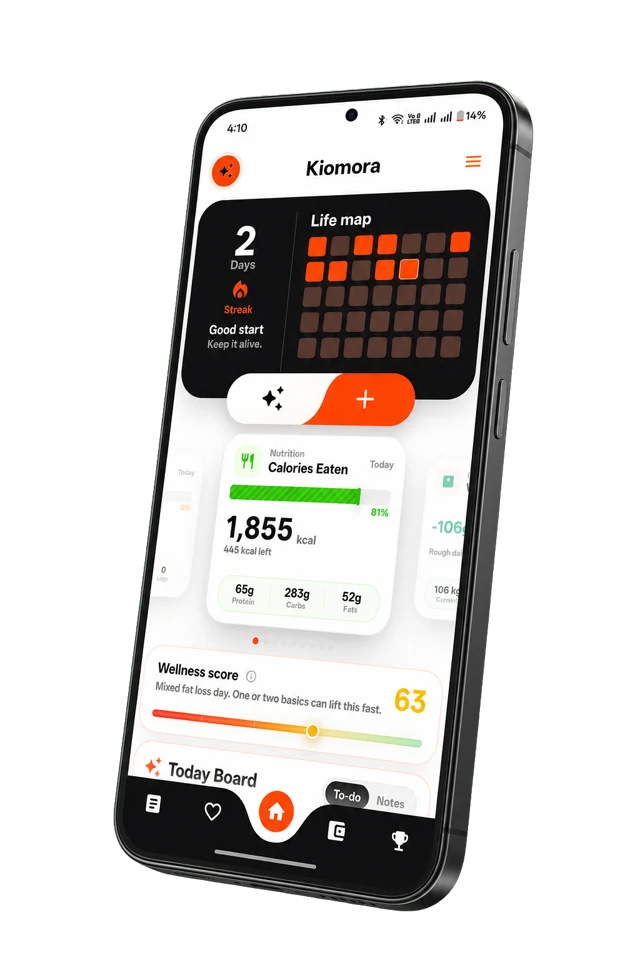
Kiomora for quick capture
Speak it. Keep it.
Capture a natural update, review the details, and keep what matters with the rest of your day.
Explore KiomoraA transcript is a block of words. A life record needs dates, categories, amounts, durations, and context that can be reviewed later. Voice logging becomes structured data only when software crosses that gap without silently deciding that every interpretation is true.
One sentence can contain several records
“Slept seven and a half hours, walked 6,200 steps, did 30 minutes of cycling, spent 350 rupees on groceries, and dinner with Maya was the best part of the day.”
A useful parser might propose sleep, steps, activity, expense, and memory entries. It should preserve the original wording, show uncertain fields, and let the person remove or correct a card.
The voice-to-data pipeline
- Capture: the person chooses to record audio.
- Transcribe: speech recognition converts the audio signal into text.
- Extract: a parser identifies supported facts such as duration, amount, category, and evidence text.
- Normalize: units and formats become consistent, such as 2 litres becoming 2,000 ml.
- Review: suggested cards remain editable and removable.
- Confirm: only approved cards enter the personal timeline.
Each stage can fail differently. A transcript may hear “fifteen” as “fifty.” A parser may correctly hear the sentence but route a future plan as a completed event. The review screen is part of the data model, not decorative friction.
What a reviewable card contains
| Spoken phrase | Suggested type | Fields to review |
|---|---|---|
| slept 7.5 hours | Sleep | duration: 450 min |
| walked 6,200 steps | Steps | steps: 6200 |
| spent Rs 350 on groceries | Expense | amount: 350, currency: INR, category: groceries |
| dinner with Maya was the best part | Memory or note | person: Maya, evidence text |
Privacy questions to ask any voice logger
- Is audio processed on the device, in the cloud, or both?
- Which providers receive the audio or transcript?
- How long are raw audio, transcripts, and structured results retained?
- Can the user edit and delete the result?
- Is the service end-to-end encrypted, or is that claim absent?
- Is content used for model training?
Kiomora does not describe itself as fully offline, end-to-end encrypted, or zero knowledge. Its privacy policy explains that Firebase, Google Cloud, OpenAI, and other providers may process information needed for supported features, and that Kiomora does not opt in to use user content for OpenAI model training.
How to make a voice log easier to review
Use concrete units, separate unrelated events with short pauses, name currencies, and distinguish completed events from plans. “Walked 30 minutes today” is easier to structure than “I should walk more.” Keep people, places, and meaningful context in normal language rather than speaking like a form.
The point of voice logging is not to make a private database compile itself invisibly. It is to reduce category switching while keeping the user in charge of what becomes part of the record.
Research and Technical Sources
- Whisper paper: robust speech recognition through large-scale weak supervision
- Koenecke and colleagues: disparities in automated speech recognition
- NIST Generative AI Profile: confabulation and data privacy
- Kiomora privacy policy
Common questions
Practical answers before you begin
- Is voice logging the same as transcription?
- No. Transcription produces text. Structured logging takes another step by identifying supported events and values, mapping them to fields, and presenting the result for review.
- Can a voice parser misunderstand a log?
- Yes. Speech recognition and structured extraction can both be incomplete or wrong. Important values should remain editable before saving.
- Does Kiomora process SuperLog entirely offline?
- No. Kiomora may send content required for SuperLog and some Ask requests to its backend or processing providers. The current privacy policy describes this directly.
Don't forget to try Kiomora
See more thanone detail
Keep the useful parts of each day in one record you can return to.
Explore Kiomora