Start with a decision
“Track my productivity” is too broad. A useful plan names a question and the decision that could follow. If no answer would change anything, the field is probably unnecessary.
Free personal tracking plan
Use one worksheet to define the question, the smallest useful fields, the review rhythm, and the point at which a tracker should change or stop.
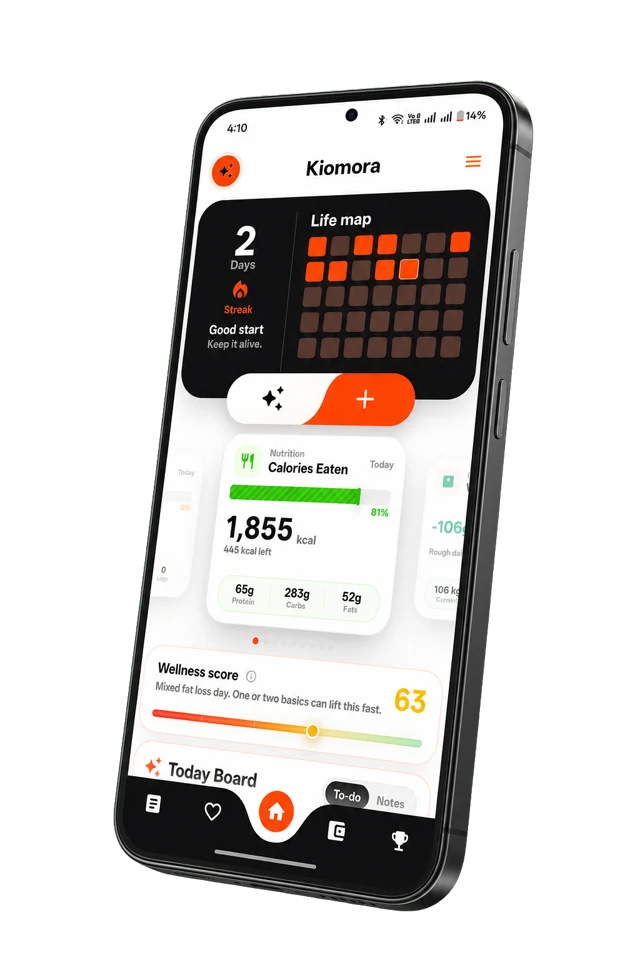
Track your whole day
Food, sleep, movement, spending, notes, habits, and memories stay connected in one personal record.
Explore KiomoraCopy it into a notes app, download the plain-text file, or print this page. Leave a field blank when it does not improve the later review.
PERSONAL TRACKING PLAN

1. THE QUESTION
What do I want to understand, remember, or change?
Why would the answer be useful?
What would I do differently after learning it?

2. THE SMALLEST USEFUL RECORD
Outcome or experience I will record:
Possible context worth recording:
One plain-language note:
Fields I am deliberately leaving out:

3. THE ROUTINE
When will I capture it?
How long should one entry take?
What counts as an intentional rest or skipped day?
What will make capture easier?

4. THE REVIEW
First review date:
Review frequency:
Calculation or comparison I will use:
Question I will ask during review:

5. THE STOP RULE
I will simplify this plan if:
I will stop tracking if:
I will continue when:

Note: A personal tracker supports reflection. It does not establish medical, psychological, nutritional, or financial causes.
Completed example
The example limits the record to fields that support one review question. It also names what the tracker cannot prove.
Question: Does a short walk before my afternoon work block appear alongside more focused work time?
Useful decision: Keep, move, or drop the walk experiment after four weeks.

Outcome: Focused work minutes from 2 p.m. to 5 p.m.
Context: Walk completed, walk minutes, sleep hours
Plain-language note: Unusual meetings, travel, or interruptions
Left out: Calories, pace, heart rate, and a detailed task list

Capture: One entry at 5 p.m., under 60 seconds
Review: Every Sunday for four weeks
Comparison: Average focus minutes on walk and no-walk days
Stop rule: Simplify if I miss more than half the entries for two weeks
“Track my productivity” is too broad. A useful plan names a question and the decision that could follow. If no answer would change anything, the field is probably unnecessary.
A number records what happened. One short note preserves the meeting, travel day, illness, celebration, or interruption that may make an unusual value understandable later.
Decide in advance when the experiment ends, simplifies, or becomes part of your routine. This prevents a temporary question from becoming permanent life admin.
Use the matching free tool to test the workflow before committing to a long tracking routine.
Test sample data in the Analytics Sandbox